

Summer is winding down, the school year is approaching and for moms these two transitions often create an overwhelming schedule. It does for me. When lack of time is a problem, caring for myself is the easiest task to set aside. So many mothers I work with are balancing this also. Time is too little and wanting to feel better is great.
This month, I want to clarify one of most time consuming issues in women’s health: abdominal separation. It has a long conversational history; abs ‘splitting open’ and permanent core damage. This is all ‘part of being a mom’, but this is just not true. Let me give you some shortcuts by explaining what it is, what we do unknowingly which make it worse, and what to do about it.
What Is An Abdominal Separation Exactly?
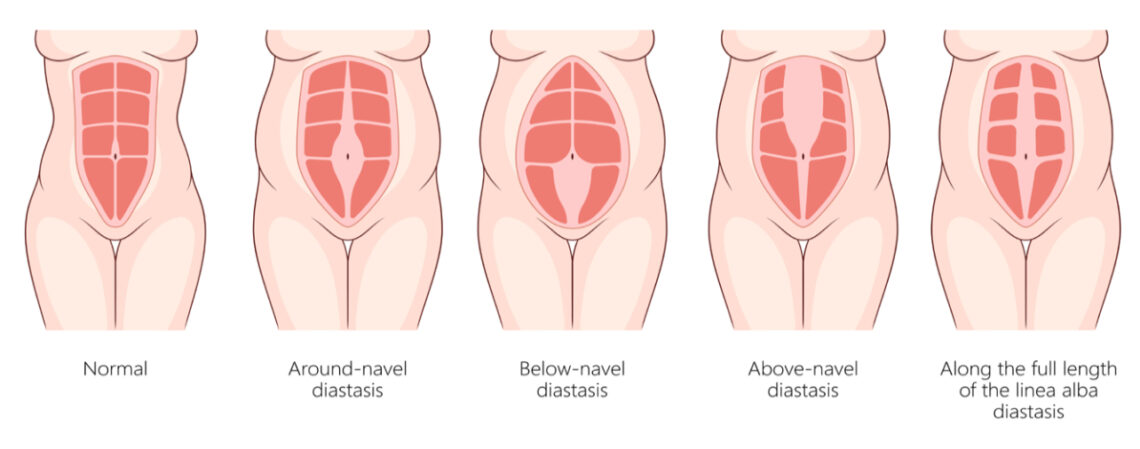
Abdominal separation or Diastasis Recti (DR) is a wider-than-normal separation of the right and left sides of the main abdominal muscles called the rectus abdominis (six pack muscles). Some degree of DR is actually normal and necessary for pregnant mothers. It’s how the body makes space for a growing baby. In fact, research shows that by the third trimester, virtually everyone experiences it.
There’s no avoiding this physical change and that can scare a lot of women. I don’t blame them. What to do about it is rarely spoken about. The best scenario is that once baby isn’t in utero anymore, the gap closes again naturally.
Factors That Increase Severity Of Abdominal Separation (DR)
Unknowingly women are making their DR worse. Weak six-pack muscles aren’t the cause of DR so that’s why traditional and often prescribed moves like sit-ups won’t fix things, in fact they can make it worse. Poorly managed intra abdominal pressure and alignment problems are key drivers of this problem. Intra abdominal pressure (IAP) is the pressure inside our abdomin.
It is like a balloon filled with air. If we squish it, which is what happens when we do sit ups, the pressure inside increases. Sit-ups alone don’t cause an ab separation it’s the trauma in combination with this move which is problematic. Spikes in IAP contribute to ab separation by pushing outward on the already compromised abdominal wall and the pelvic floor. Breath holding and sucking in our abdominals also spike IAP and makes ab separation worse.
Management
Stay in neutral alignment and manage the pressure. Neutral alignment is when ears, shoulders, ribs, and hips are all stacked on top of the other when viewing yourself from the side. This will relieve unneeded stress to musculature, ligaments, and core.
Strengthen safely. The first step is to begin in neutral alignment. Once mastered build strength with 360 ° breathing which activates the deeper core muscles underneath the six pack. Correct breathing also helps manage IAP. Practice this by sitting in good alignment, breathe in using the diaphragm. The chest isn’t moving much during this process. Breathe out slowly exhaling all air until the abdominals feel a bit of fatigue. Lastly, relax the belly and pelvic floor after the full exhalation and then begin again. Continue these cycles until your abdominals are tired. Exhale on effort.
The good news is that abdominal separation isn’t something you simply have to live with after having children. Small consistent changes in how you breathe, move, and use your body throughout the day can facilitate the natural process of healing fully. You don’t need hours in the gym or endless core exercises—you need this approach. Build health back strategically. Training for the job we do daily will leave us feeling strong, supported, and confident again.