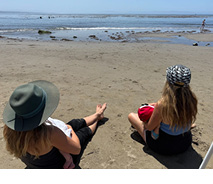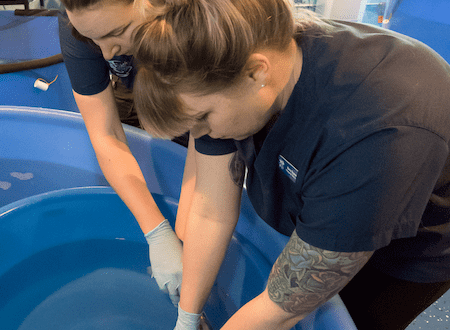


Whether you’ve grown up in Santa Cruz, moved here from elsewhere, or are simply visiting, you’d likely agree that Santa Cruz is the kind of place where people can experience a profound connection to their natural and social environment. The mild weather, oceanic delights, and forest covered mountains elicit a sense of paradise and peace, and the prevalence of people in community with others inspires a sense of belonging and purpose. Santa Cruz is truly wondrous and unique!
Unfortunately, Santa Cruz is also similar to other cities across the country insofar as there’s trash carelessly strewn about the streets and there’s an unsightly obstacle course of dog poop on most every sidewalk and path. It’s time that we do something to change that!
Soji
In Japan, people practice what is known as sōji. Sōji means “cleaning” or “tidying up.” That may sound simple and familiar to us (we clean our rooms, wash our dishes, and throw away our trash), but the implications of sōji as a cultural practice are far more profound and pervasive. In Japanese culture, adults very intentionally inculcate in children a sense of mindfulness in every task and activity. As such, keeping things clean, tidy, and welcoming is far more than a chore; it’s a calming and focused ritual, an expression of consideration, responsibility, and humility, and a way of building community. In short, sōji represents what we might refer to as stewardship.
Stewardship
Stewardship is “the careful and responsible management, oversight, or protection of something entrusted to one’s care. It means taking an active role in looking after resources, property, or the environment so they remain safe and healthy in the future.” The key takeaway from that definition is that we can redefine what and whom we think of as being entrusted to our care and then model that care with and for our children.
Indigenous Teachings
Imagine a world where we considered the care of children to be entrusted to all adults and a world where we showed care and consideration to everyone regardless of familial affiliation. In tribal cultures, adults often collectively share the responsibility of raising children, and they treat fellow community members like their brothers, sisters, mothers and fathers. The indigenous peoples of the Americas are also known to live in harmony with the natural environment under the belief that “we do not inherit the earth from our ancestors; we borrow it from our children.”
Positive Discipline
While our modern-day American culture is largely devoid of indigenous values, Positive Discipline offers a refreshing way of practicing and modeling stewardship. Far more than an encouraging parenting methodology rooted in the belief that meeting children’s needs for belonging and significance helps them to feel and do better, Positive Discipline offers a valuable framework through which we can transform our culture of violence into one of respect and convert our tendency toward carelessness to one of consideration.
Gemeinschaftsgefühl
Psychologist Dr. Alfred Adler, whose ideas underlie the theoretical framework on which Positive Discipline is based, coined the term gemeinschaftsgefühl (“community interest”). Positive Discipline co-founder Jane Nelsen describes gemeinschaftsgefühl as “the state of social connectedness and interest in the well-being of others that characterizes psychological health.” Much like sōji, it teaches children that collective stewardship is the key to collective prosperity.
Practical Applications Of Gemeinschaftsgefühl
The following represents just some of the ways that we can model stewardship through the lens of Positive Discipline and the practice of gemeinschaftsgefühl.
At home:
- sharing the tasks/projects that keep the home clean, functional, and beautiful
- eating together and everyone having a chance to share with and listen to each other
- comforting a family member when they feel sad or upset
- addressing family arguments through the collaborative identification of fair solutions
At school:
- students and teachers work together to create a safe and harmonious learning space
- collaborative problem solving, goal setting, and establishment of rules and schedules
- peer support systems in which students help classmates who are struggling
- shared project ownership where all students play vital roles that help the team succeed
- empathy and inclusion, as well as celebrations related to cultural/religious diversity
- welcoming routines where students greet each other express gratitude or support
- restorative circles that invite honesty, reflective listening, and solution-oriented thinking
In the community and natural environment:
- neighbors sharing tools in a community garden
- volunteers fixing up a playground
- people cooking meals for a sick neighbor
- local groups organizing after-school clubs
- neighbors planting trees together
- community-wide trash cleanups along a local river or beach
- farmers engaging in regenerative practices that enrich the soil
- protecting local wildlife and preserving green spaces
- supporting leaders/legislation that promote social equity and environmental protection
Conclusion
There is a religious teaching that saving even one life is like having saved the world. The unfortunate irony is that people often tend to do nothing when faced with an overwhelming task. Fortunately, saving the world does not rest on any one person’s shoulders. Each of us has a role to play, and working together, we can effect significant change. The opportunities for stewardship are innumerable and the benefits of it are immeasurable.