
A mother’s body endures progressive change over the course of the nine months. As her belly grows, alignment shifts naturally and ligaments loosen.
This predisposes the body to aches and pains and exercise becomes more difficult when things already hurt. The need to keep the body functional and out of pain during this time becomes a priority, thus a specific approach to exercise will balance out this disproportion.
One of the first places mothers turn to for guidance are health care providers who often tell them to “ease into a routine and maintain low intensities” or that “walking and yoga are best.” We should consider if these suggestions are the most helpful during pregnancy.
This is not to negate the advice of doctors or to ignore the benefits of walking or yoga, but vague guidelines do not help expectant mothers who need to be doing very specific things. Staying strong while pregnant must include mastering specific exercises and using the correct intensity.
Participating in a regular fitness routine is advantageous for both maternal and fetal health. Preparations for pregnancy, and the time beyond, must include training the body for what we repeatedly do. Motherhood involves maintaining good posture with good core strength, lifting heavy loads, bending, reaching above head, single leg strength, and balance.
These results require specific efforts. For example, a marathon runner who trains only in good posture expecting to run faster will be a slow runner with excellent posture. Definitely not the outcome they wanted.
Mothers, whether they realize it or not, are asking their bodies to run a marathon and need to train for it. Training must include specific motherhood moves.
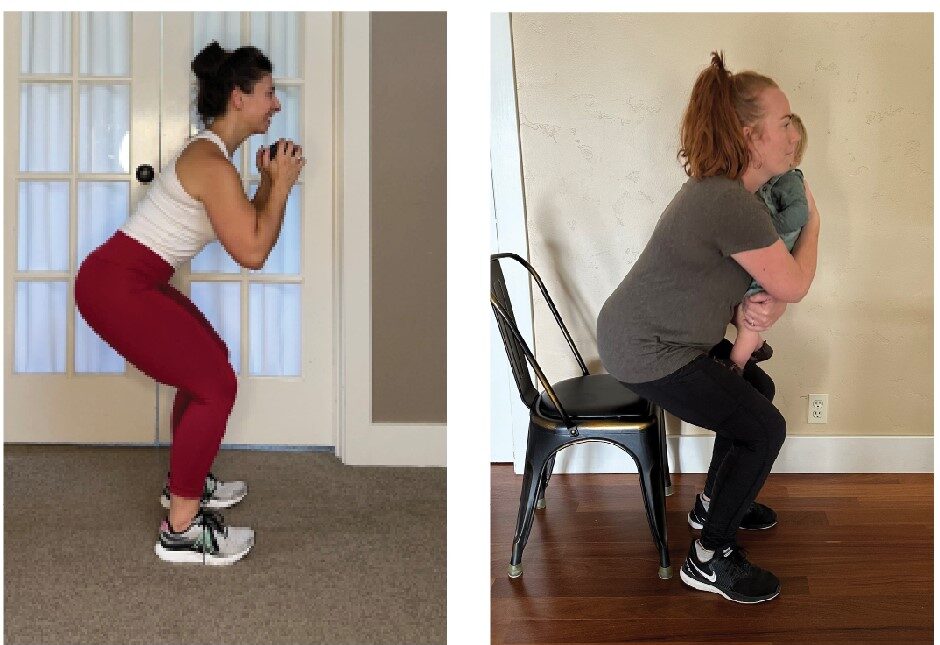
Mothers get up and down many times a day and doing so with a baby is much more challenging. Young children can weigh 35 pounds. So one of several prescribed exercises is the weighted chair getup which helps mothers perform getting up and down many times a day with their little one with greater ease. (See picture) This and many others should be integrated both prenatally and postpartum as long as there are no medical contraindications or pain. This is why walking more or trying yoga are not adequate if you are asking your body to work in very specific ways.
Training the body more specifically by performing some of these exercises mentioned is great. But during pregnancy mothers also need to be aware of their workout intensity.
Monitoring intensity is important while pregnant but, once again, the guidelines can be vague. What exactly do health care providers mean by low to moderate intensity when they suggest these ranges? The American College of Obstetricians and Gynecologists (ACOG) recommends measuring intensity without fancy monitors or making guesses about heart rate. While heart rate is a well known strategy for determining intensity for the general populations, during pregnancy heart rate is variable and changes due to many factors.
To determine safe exercise intensities use the Rate of Perceived Exertion (RPE) scale which relies on listening to your body and how you feel. One would rate their own intensity by grading their efforts with these numeric labels. For example, an RPE of “one” represents no work effort, maybe you’re walking early in pregnancy. A “ten” represents working your hardest by lifting something very heavy that your could only lift once.
The best ranges for pregnancy while exercising falls between an RPE of five to seven, which is considered strong intensity. Notice however, these recommendations by ACOG are much higher than the general recommendation. The RPE scale is a better way to listen to your body and gauge the effectiveness of your exercise.
Navigating exercise during pregnancy offers a remarkable opportunity for moms to gain strength and give themselves an advantage postpartum. With my first pregnancy, I wasn’t sure where my knowledge and the doctor’s recommendations were in agreement in the gym.
For this reason, I made it my goal to understand prenatal and postpartum exercise and educate women. With my specialist certification, I share this knowledge with clients so they can be strong like a mother. Women following these steps can change the negative narrative around having a Mom Bod because it will represent a body that is fit and functional.