
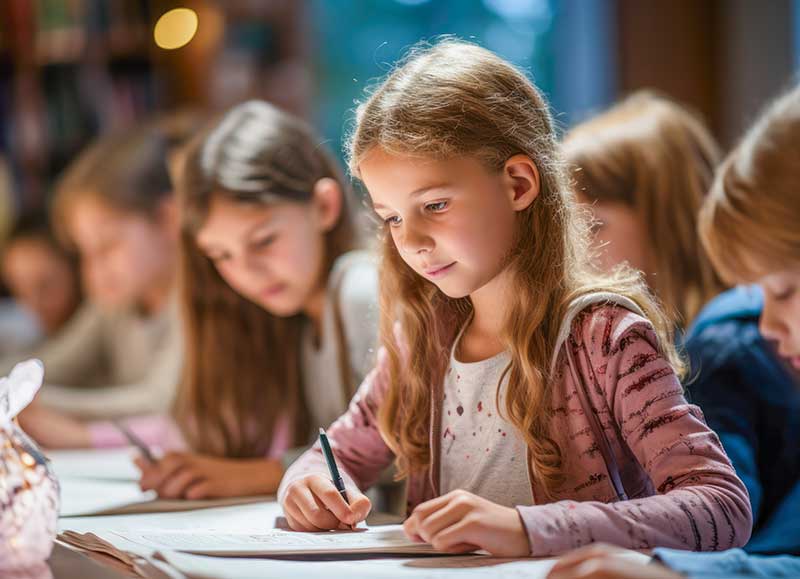

I’ve been teaching writing to children for almost 20 years now, first in small homeschool groups, then online since 2013. My students have ranged from reluctant writers who can hardly put out a sentence to avid writers who forget to eat when their creative juices are flowing.
In the time that I’ve been teaching, I’ve noticed public school curriculum doubling down on technical writing skills. They’ve pushed essay-style writing earlier in the curriculum and even early elementary students are tested on writing skills.
In that same time, however, I’ve done the opposite.
I’ve tried teaching essay writing to children, and it was miserable. Teaching creative writing, on the other hand, is a joy. And learning, it turns out, doesn’t come from misery. Just ask scientists.
In the last 20 years, brain research has galloped ahead, disproving many of the old standbys of education (no, cramming doesn’t work; no, you shouldn’t study in a distraction-free environment; no, focusing only on what a student can’t do doesn’t inspire them to learn).
Research has also proven that when our brains are relaxed and happy, they learn better. That’s why I teach writing skills in the context of creativity, whether the young writer finds writing a sentence torture, or the young writer derives great joy from the process.
Creativity offers young writers an environment where they can blossom:
Reluctant writers need an environment where there is no “wrong” answer, where they know that they won’t be judged, and where they can express their own interests and ideas. Creative writing allows them space to play, and when they play they relax, and when they relax, they forget to worry about writing.
Avid writers feel constrained by unnecessary boundaries on their creativity. When the work they are allowed to do in an academic setting is set within strict boundaries, they see their passion for writing restricted. When they are told in elementary school that “good” writing is restricted to certain forms, they learn to constrain their own impulse to develop a strong, unique voice.
Once students feel free to write, a creative environment lets them use writing as a tool to express themselves. In a creative environment, most students choose to write fiction, though some students do choose to write nonfiction or poetry. (One of my students was obsessed with sports cars and wrote pages upon pages of descriptions of cars, their features, and histories!)
But the most important thing about the creative environment is that they choose to write.
Any writer can tell you that the first step toward becoming a better writer is simply to write, write more, and write again. Writing can always be fixed in the revision process—that’s easy. But when there’s nothing to fix—that’s what we call writer’s block. And writer’s block sets children up for a lifelong struggle to express themselves in words.
But what about learning how to footnote and cite sources? What about being prepared to write term papers? What about college application essays?
For a child already inspired to express their ideas, these hurdles are mere speed bumps.
Think of it this way:
If we focus on telling children that there are strict rules to writing, that their writing will be judged, and thus that writing is anything but fun, they will become anxious, rule-following writers. At best, they’ll write enough to fulfill the assignment. At worst, they’ll find themselves unable to write at all.
But if we focus on helping children become fluent, fluid, happy writers, they’ll learn to write down whatever is on their mind. Maybe what’s on their mind is a fantasy story, or maybe it’s a manual about sports cars—the content doesn’t actually matter. Later, when they start to have more specific demands on their writing, they’ll be able to draw on that fluidity and access to their inner voice.
Frankly, it’s really easy to teach a teenager how to cite their sources. But it’s nearly impossible to tell a teen who dreads writing that writing is a fun way to express themselves.
The fun has to come first. Save the rubrics and restrictions for when they matter.
Suki Wessling is a local writer and educator. Her new book, How to Make Magic Real, was inspired by teaching students online during the pandemic. Learn more and purchase at www.SukiWessling.com or buy it at Bookshop Santa Cruz.