
We love to find children’s books that have something valuable to say while they entertain us, giving us things to talk about and remember. Three recent favorites do that, each in very different ways.
This Is Not My Hat By Jon Klassen
This is a small masterpiece of comic timing and visual storytelling, hilariously simple. A tiny fish has stolen a hat from a very big fish and is narrating his escape with a kind of calm confidence that borders on denial. “He probably won’t wake up for a long time,” the little fish assures us. “And even if he does, he probably won’t notice that it’s gone.” Children will laugh because they can see what the tiny fish can’t. In the background, the big fish has already awakened. He has already noticed. He is already on the move. The joke grows funnier as the distance grows between what is said and what is clearly happening. Klassen lets the story unfold in a series of images that carry a dry, almost deadpan humor. It feels closer to silent film comedy than to most picture books. The restraint is what makes the punchline land harder. Beneath the humor, there is a morality tale. Not a finger-wagging lesson, but something simple and effective. Actions have consequences. The little fish insists he will get away with it, but the reeds part, the water darkens, and the story resolves in a way that feels both inevitable and a bit shocking.
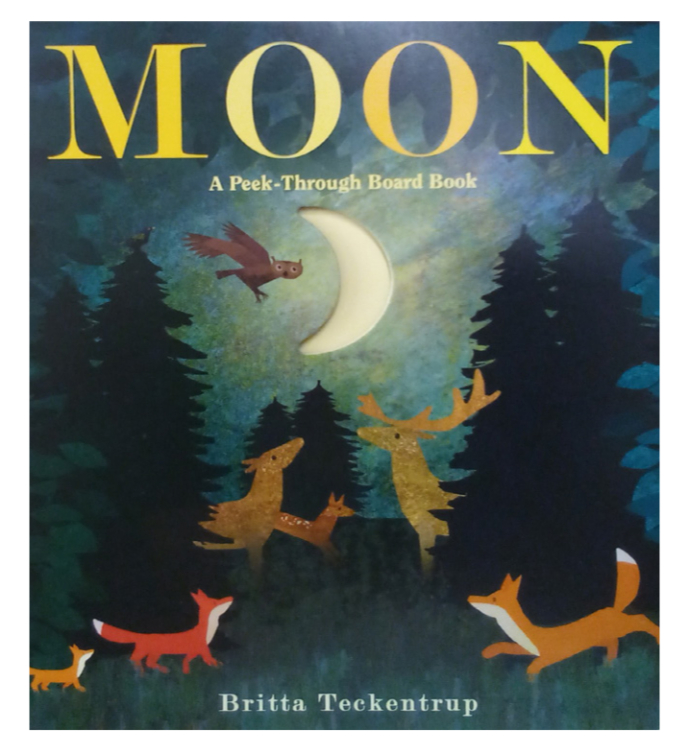
Moon By Britta Teckentrup
It’s a joy to see a children’s book that follows the classic rule “show, don’t tell.” And then, as the final pages turn, what is not shown becomes the whole point. Moon by Britta Teckentrup turns its gaze upward and outward, with the night sky opening up overhead, wandering the world, following the phases of the moon—waxing and waning, full and new, the steady rhythm of change. It unfolds through rhyme, through repetition, through a cadence that invites reading aloud. This is where the book does something special. It becomes an introduction to poetry without announcing itself as such. The language carries a musical quality that children can latch onto, even before they fully understand the meaning. There is pleasure in the sound of the words, in the way they echo and return. It is the kind of book that a child will ask to hear again, not just for the story, but for the rhythm itself. Teckentrup’s illustrations deepen that experience. The pages often feature cutouts that reveal the changing shape of the moon, creating a sense of discovery with each turn, transformation, of something constant that still appears to change. Adults will appreciate how the book manages to teach two truths at once. The science of the moon’s phases—moon as object—and the mythic, intuitive sense of the moon as companion, as something that watches over us. On our nighttime journey across the world, we discover how we share the same moon with many creatures, all with very different lives.
Others By Kobi Yamada
Together, these two books make a thought provoking pair. One looks inward at the stories we tell ourselves, the other outward at the cycles and seasons that shape the world. Both respect the intelligence of their readers of any age. For those who have been following along with past favorites, it is worth noting a new release from a familiar voice. Others by Kobi Yamada explores how our minds can build up the unfamiliar into something scary or strange, causing us to see only differences between ourselves and others, until we take the brave step of actually connecting—and discover how much we share in common. Like Moon and This Is Not My Hat, the lesson is delivered through images as much as text, creating a vivid memory. The best children’s books say as much to us as to the kids beside us. Over the past two decades, he has become a leading voice in what might be called “the literature of encouragement.” His books, including What Do You Do with an Idea? and What Do You Do with a Chance? have sold millions of copies and have been translated into more than thirty languages. Yamada’s own story reminds us that every dream begins with the courage to chase it. It’s the reason Chasing Dreams feels authentic: Kobi Yamada has lived the message of his own book. For decades he helped build Compendium, and then in 2024, a remarkable milestone arrived. Penguin Random House, one of the most time-honored publishers, acquired Compendium. Yamada remained president and continues guiding its creative direction, now with the resources and reach of a prestigious and legacy-building publishing house.
By John Louis Koenig