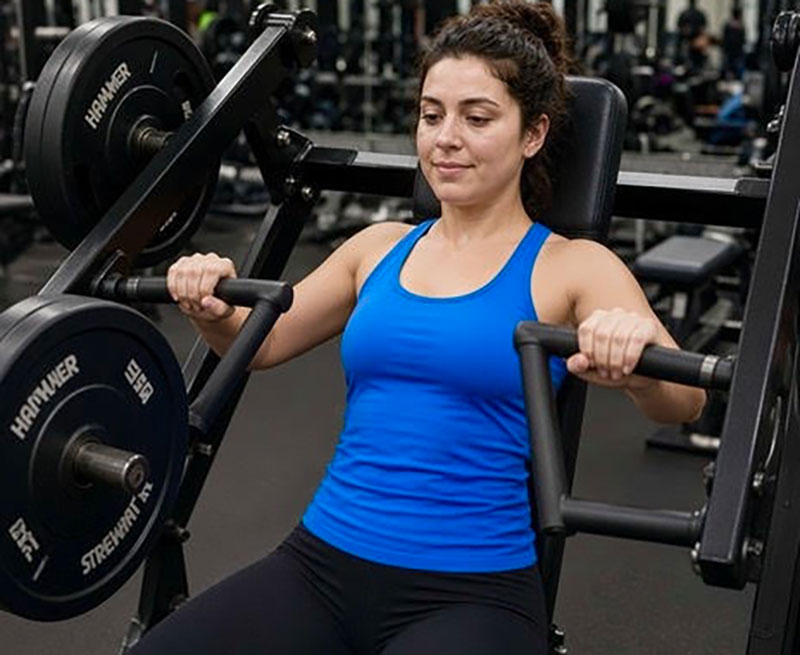

If you’ve ever felt nervous or unsure what to do at the gym, you’re not alone. Having confidence at the gym takes some know-how other wise it can be overwhelming or intimidating. What I would recommend is to begin on machines. Gym machines are a great way to start working out at the gym for several reasons.
They allow a controlled path of motion, a stable support to your body, easier muscle isolation, and a very measurable force output to track your efforts. They are also a great way to gain strength, protect healing injuries, or for those wanting to prioritize safety and muscle isolation. Even though I am not a beginner to weight lifting or machine use, I still find machines challenging and use them periodically for muscle isolation. So, don’t get me wrong, they can be intense even though I am categorizing them here for beginners. The trouble is they aren’t fool proof. I have seen many people at the gym using them wrong and it pains me to know they are putting themselves at risk for injury!
Poor set-up can incorporate and overwork tendons, ligaments, and muscles unknowingly, increasing that risk. Sometimes, despite adjustments, anthropometrics vary; not every machine fits every body equally well. I am petite so there are machines that do not fit me and I will never use them.
Knowing this is important and asking a trainer for demonstrations and guidance would be wise. This is a free service at most gyms. Even so, there are still some basics to learn which will help. Gym machines facilitate some basics about good form and create a foundation for progression to free weights.
First, choose the right machines and use them all in rotation two to four times a week. A well organized gym will place machines in the same area which work similar muscles. For example leg machines are typically close together and upper body machines are clustered close elsewhere and all should be labeled. Utilize the five main movement patterns: push, pull, hinge, squat, lunge. Machines accomplish all of these movements.
Pushes press resistance away from your torso like the push-up and over head shoulder presses. The machine for shoulder press is called ‘shoulder or overhead press’. This is a chest and arms move.
Pull movements are exercises like pull ups, latissimus dorsi pull downs (lat pull downs-the opposite of the pull up) and seated rows and plank rows. The machines are called ‘Lat Pull down’ and ‘Seated row’. These focus on your back.
Hinging involves the glutes and the hamstrings done with moves like the squat, leg press, and squats with the Smith Machine.
Squat is any exercise where the knees and hips are bending. Master the squat! It is a move we do many times a day, picking things up off the floor and lifting things. Building strength here will allow so much functionality in life. The Leg Press machines and Hip Sled can be used for this and also the Smith machine.
Lunges are single leg knee dominant moves. I feel like I’m repeating, but the Smith machine will set up the body to preform this as well. The move is called a lunge. If one masters the Smith machine, actually all these moves can be done from it.
Lastly, understanding how to find the appropriate amount of weight is intimidating for gym users. I tell my clients to use your body as a guide and lift what feels very very heavy the last two repetitions or so.
At first, you will have to guess the weight to begin with and complete 10-12 repetitions and see how they feel. A rate of perceived exertion (RPE) scale rated from 1-10 your guide. A 1-at rest and 10-all out effort/can only be done once or for a short amount of time. When choosing a weight amount, those really hard last repetitions should feel like a 7 or an 8 on this scale. Intensity is so important to get right in order to gain the strength safely and not waste time exercising without progress.
Also keep in mind, start small because muscle soreness, officially referred to as delay onset muscle soreness (DOMS), sets in 24-72 hours after a workout. This is when you will feel most sore. So wait a day or two before working out the same muscles again.
Then adjust weight amounts if soreness was too intense. We could spend a long time discussing muscle soreness how to gage workout efficacy and recovery, but for the sake of this article, just keep a good balance between soreness and workout intensity. Don’t workout a muscles if its so sore you can’t complete three sets easily.
I hope this information clarifies general use regarding gym machines. However, if you’d like more one-on-one support learning your body’s mechanics to ensure which machines will suit you or which adjustments to make, contact me for a complementary movement screen. Happy Workout!