
You don’t visit the mall looking for history.
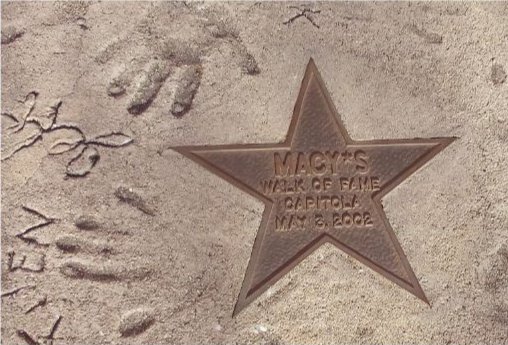
You might be excited about finding friends or feasting on a cinnamon pretzel. Or maybe just a little air-conditioning and losing yourself in a place so big that holds small treasures. And then you see it, by the door to Macy’s at Capitola-something that doesn’t match the giant signs and flashy posters of the mall: handprints were pressed into the cement walkway like movie stars do in Hollywood. And in the middle of handprints and footprints and carved names and initials sits a bronze star-shaped memorial plaque, the kind of object that makes you think something special happened here.
You can walk past things like that a hundred times and never see them. But when you do, you don’t forget. And the kid in you begins to wonder: “Whose hands are those?” “Why are they here?” “Can I put my hands on top of them?”
That’s the moment. The tiny spark. Curiosity flicking on like a porch light.
This is how human beings have always begun their detective work. We find marks. We find things placed in the world with intention. We find clues that tell us what was. From the enormous stones stacked into pyramids, to the first handprints painted onto cave walls and hands pressed into concrete, people have always been leaving signs behind, as if saying, I was here. Those hands belonged to real people-kids, parents, hunters, builders-living lives as busy and confusing and important to them as ours are to us. And once you start thinking about that, curiosity can take over. You begin to imagine whose hands they were, how big they were, what those people cared about, and whether they knew their marks would last so long.
You imagine yourself in their place and realize that even small things -a name scratched into a bench, a handmade cross by a roadside-can echo through time far beyond the moment they were made. And our brains do what brains do: we ask, who made this? What happened here? Why do we remember some things, but not this?
Santa Cruz is full of these “quiet artifacts.” Some are official-plaques and statues, others are accidental-a fading sign ghosted onto a wall, a date stamped into concrete. Earthquakes leave their marks in the way towns rebuild and how people talk about “before” and “after.” War memorials speak the message “we will not forget.” Even the simplest dedication, “In memory of…” or “In gratitude for…” are doorways into bigger stories.
For parents, these discoveries can become impromptu teaching opportunities, and not in the preachy way. More like: Let’s wonder together. Let’s chase the answer. Curiosity might be its most potent, its most fun outside the classroom. And here’s the great trick: you don’t even need the answer right away. Just stand there and feel the odd attraction of it-human beings reaching forward through time, trying to be remembered. Even if what they leave behind is just a handprint in drying cement.
So what is the Macy’s “walk of fame” outside the Capitola Mall store? We know that Macy’s has long been a celebration of American pageantry and tradition through the Macy’s Thanksgiving Day Parade, beginning in 1924 and becoming a national televised ritual. But Macy’s had another, more local, now forgotten kind of theater: grand openings staged as civic events, designed to make a national chain feel like a neighbor. In the Bay Area, Macy’s grand-opening promotions included inviting kids, community members, and long-time Macy’s employees, to press their hands into fresh concrete-a “we were here” moment that’s half celebration, half time capsule-they were a ceremony-a way of saying: We’re here, we’re part of the community now.” And in 2002, before today’s wide-eyed mall rats were born, the community helped “make the mark.”
The bronze star plaque beside them-more solemn, more memorial-functions like the other quiet markers around town: a reminder that people leave meaning behind. Sometimes in ways that outlast the intentions that created them.
Santa Cruz is a landscape of small mysteries hiding in plain sight. This month it’s handprints and a star outside a department store. Next month? Who knows. Maybe a strange staircase, a vanished building, a plaque nobody reads anymore. Noticing and wondering together is the whole point of “Growing Up Curious.”
So if you’ve got a kid beside you-or if you’re trying to stay a kid yourself-try this: Stop. Look down. Ask the question out loud. Then follow the thread.
By John Koenig