
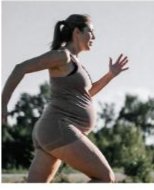

Should I Avoid Running While Pregnant?
It depends. Running isn’t contraindicated during pregnancy, especially if you have always been a runner, but there are some things to consider. If you haven’t been actively running and decide you want to start now that you’re pregnant, I would ease in. Start by walking and increasing the duration as tolerated. Caution should be taken because of the anatomical changes of a bigger belly and the ballistic forces put on joints and the pelvic floor when women run. Joints become so susceptible to injury since our bodies produce more of the hormone relaxin during pregnancy.
You don’t have to avoid running altogether, but you should prep the body for this stress strategically. Please reach out to me if you’d like a more in-depth plan.
Here’s one test to do: Mimic a running pose by raising one leg slightly bent behind you with the other foot forward. Using the front leg, perform a slight squat. Bend that standing knee at least 45 degrees and then look at your hips. If they stay level this is a good sign you’re strong enough to endure the impacts of running.
Is It Safe To Start Exercising Now That I’m Pregnant?
Yes, and it will be so good for you! Studies have shown both cardio and weightlifting reduce pregnancy complications, help with weight management, produces better labor outcomes, faster recovery, and better sleep, to name just a few. Babies also benefit. In a 2021 review by BMC Pregnancy and Childbirth entitled, “Effects of exercise during pregnancy on maternal and newborn outcomes”, showed that babies had higher APGAR scores (Appearance, Pulse, Grimace, Activity, and Respiration).
The trick becomes how to do it safely. Generally speaking, moms need to listen to their bodies during workouts. How your body feels changes daily or weekly, so one day the same workout will be more difficult than others. The best way to manage safe ranges while working out is using the Rate of Perceived Exertion scale. In the R.P.E. scale, a 1 represents effort at rest and 10 is maximal effort. The kind you can’t sustain for longer than short bursts. Interestingly, women who are pregnant should be pushing their bodies harder than one might expect: a number 6-7 on the 1-10 scale.
If it helps to have a percentage, this is 60-70% of your all out effort. Using the RPE scale to measure intensity will be safe for you and baby as it your abilities as they change. This can be applied to both cardio and weight lifting.
My Youngest Is Three Years Old And I’m Still Having Pelvic Floor Problems. I Leak A Bit When I Cough. Is This Normal? Can I Do Anything At Home?
I’m so sorry you are experiencing this. Yes, it is normal for these problems to appear. The trouble is many women resign themselves to feeling as if it is now their new normal. It is not. I hear so many women who say, “I’ve had kids so, I pee when I sneeze now.” Nope! This doesn’t have to be your new normal. This is your body telling you that your pelvic floor needs some rehab. It is your body telling you it needs some care.
I understand it is embarrassing, but it doesn’t need to be. It’s not a reflection of something you’ve done wrong or if you are in shape or not. It’s your body’s response to trauma and it is very common. Labor, pregnancy, hormonal shifts, and anatomical change do some serious rearranging on our bodies! Even in my own pregnancy and delivery experiences, education and support for women around physically training for these exact problems hasn’t been clear. That’s why I pursued my specialty certifications.
There is an abundance of information and strategy, so I was never sure which approach was the truth. A popular exercise is kegels. A very well-known exercise, but in my field, I can design whole training programs around pelvic floor health which is incorporated into the exercise programs. Because healing is more than just one exercise. This piece is something doctors can’t and don’t give. Not to put down doctors! It’s just not in their scope. What I can give you quickly is this:
Focus on diaphragmatic breathing, good posture, and pelvic floor activation with a complete relaxation. The pelvic floor is a grouping of muscles that support your organs and they need to be trained through 360 degree activation-it isn’t enough to stop the flow of pee as with traditional kegels as this only focuses on the front of the pelvic floor. Squeeze and fully relax all the musculature, front, (stop flow of pee) back, (stop the flow of gas) and sides, (gentle glute squeeze). Do this as many times a day as you remember. I like to do them at red lights in the car.
After 6-8 weeks of an exercise program targeting the rehab of the pelvic floor, most women do feel better. Some women need to see a pelvic floor specialist in conjunction with these programs. If symptoms remain after my clients train with me for that period of time, I refer them to a pelvic floor specialist for an examination. Even years after birth, the pelvic floor can heal with these therapies. The key is not to resign ourselves and find the right help. You are not broken.
For details on how to perform these exercises scan the QR code.