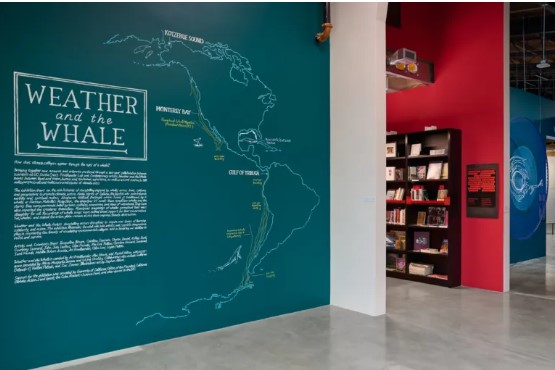

Weather and the Whale is a new multimedia installation at UCSC’s Institute of Arts and Sciences Galleries that explores climate change and the relationship between humans and marine life from a whale’s perspective.
The exhibition is the result of a two-year collaboration between UCSC faculty, marine scientists, and ten internationally-acclaimed artists. UCSC marine ecologist Ari Friedlaender and IAS Galleries curators Rachel Nelson and Alexandra Moore put together the project and assembled the group of featured artists and scientists.
Visitors of the exhibition are led on an audio-visual journey that offers a detailed and unrivaled look at the interconnection between whales, humans and their shared world.
The varied significance of whales is examined and scrutinized through historical, scientific, and sociological lenses.
A glimpse into the history of American whaling is provided by Whale Charts, which was created by the American zoologist Charles Haskins Townsend in 1935. It depicts a map of the world displaying numerous dots to indicate the locations where whales were hunted by American whalers from the mid-1700s to early 1900s. It wasn’t until 1986 that the International Whaling Commission officially banned commercial whaling in the United States. Near the Whale Charts, another display shows scrimshaws: engravings carved into whale bones and teeth, originally as a pastime for whalers while they were at sea. Most parts of the hunted whale carcasses had been previously considered useless, and whales were primarily hunted solely for their blubber. Townsend’s Whale Charts and the scrimshaw pieces serve as reminders of an enduring exploitation of whales on a scale both large and wasteful.
Ocean Sentinels and Toxins in Monterey Bay, California evaluates more recent effects of human actions on California’s marine environment by measuring chemical compounds from pesticides found inside marine mammals living in the Monterey Bay. In a video, Logan Pallin, an encophysiologist at UCSC, shared that more than 140 different compounds were found inside the bodies of three different marine mammals last year: a humpback whale, a California sea lion and a California sea otter
Pallin’s focus is on the present and future, as he voiced concern about the effects of Moss Landing’s battery storage fire on Monterey Bay and Elkhorn Slough marine life that has yet to be uncovered.
Weather and the Whale will continue to be on view until March 8, 2026. Two additional exhibitions, Sam Williams: Deep in The Eye and The Belly at the Mary Porter Sesnon Gallery and Yolande Harris: Sound Portal for Whale Bubbles at the Seymour Marine Discovery Center, will open this fall.