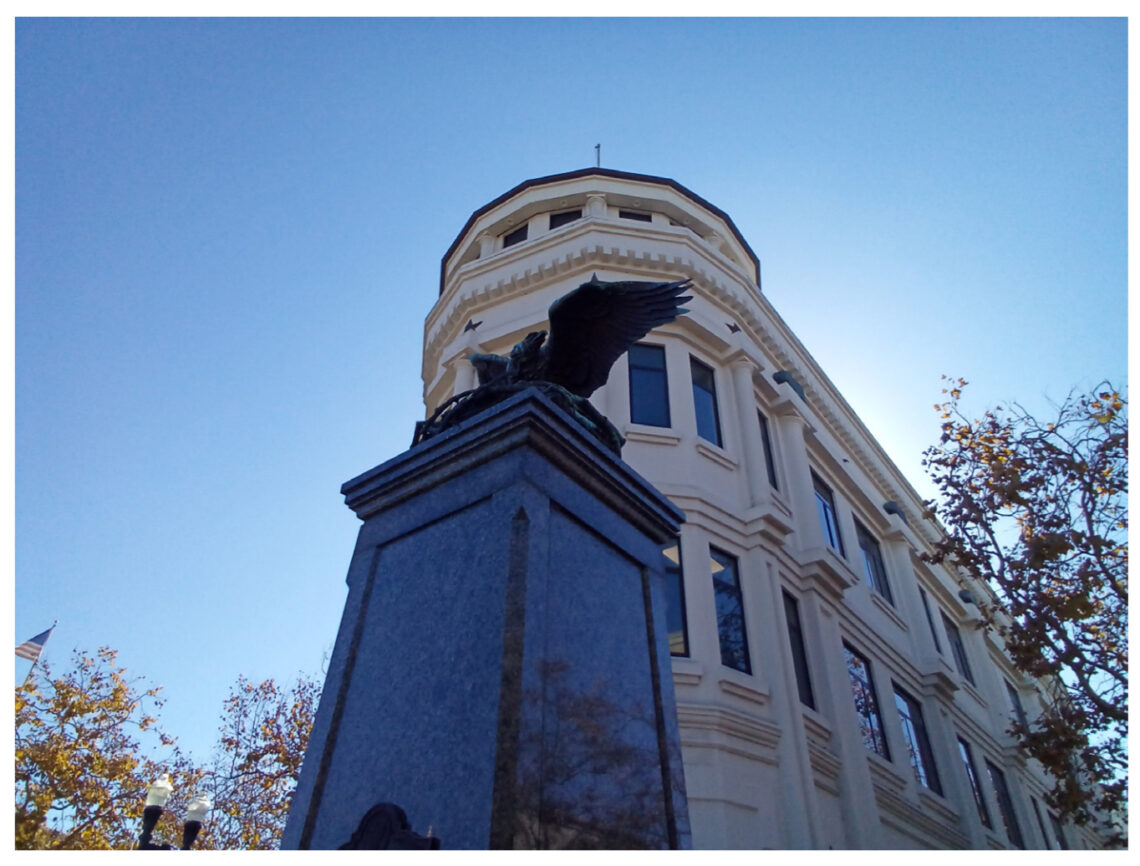
An eagle spreads its wings above a nest of young birds in downtown Santa Cruz. Beneath it, a stone pedestal holds the names of people who left Santa Cruz to go to war and never came home.
You can find it where Pacific Avenue meets Front Street, near the Veterans Memorial Building. Dedicated on Memorial Day in 1928, the monument remembers local people who served in World War I, including those who died. Its reverse honors the soldiers and sailors of all wars. That is a lot of remembering.
Welcome To 1914
Imagine a world where warplanes made of cloth and wood are a new invention, kings and emperors still rule powerful countries, and European empires control lands far beyond Europe.
Those powers are building armies and competing for territory. If war breaks out, alliances commit other countries to join the battle.
In June 1914, an assassin kills Archduke Franz Ferdinand, heir to Austria-Hungary’s throne. The murder starts a crisis, threats become declarations of war, and a regional conflict spreads across the world. Soldiers face machine guns, exploding shells and poison gas. Along the Western Front, armies fight from trenches stretching hundreds of miles. Modern inventions have made killing faster. They have not made people wiser.
The United States enters the war in 1917, and Americans, many mere teenagers, join the fight. Some volunteer, many are drafted, and many never come back. Some are from Santa Cruz.
The War To End War
People called it the Great War, “the war to end all wars.” After such terrible destruction, surely nations would find another way.
On November 11 of 1918, at 11 in the morning, an agreement to stop fighting, called an armistice, took effect between Germany and the Allies. It became a moment to remember.
America first commemorated Armistice Day in 1919. In 1938, it became a legal holiday dedicated to world peace. The following year, World War II began in Europe.
Sixteen Days
Our eagle memorial bears the name of Fay Mudie Wyman, born in Soquel in 1892. A family history, quoting a newspaper account, says he survived two infantry charges across the no-man’s-land between opposing trenches without being wounded. Then, in a rest camp, another soldier’s gun went off while it was being cleaned. The bullet struck Wyman, who died on October 26, 1918—just sixteen days before the Armistice. He was 26.
His name on our memorial tells us he died. Now you know how close he came to coming home.
When Trees Were Memorials
At Santa Cruz High School, remembrance became part of the school itself.
In 1919, the names of 11 former students lost in World War I were carved into the entrance hall’s marble, beneath the words “Freedom Cometh Not Free.”
Eleven black walnut trees were planted around the athletic field in the early 1920s, one for each life. Memorial Field was dedicated on May 9, 1924. Plaques at Myrtle and Taylor streets record the dedication and the students’ names.
Two of the walnuts were removed during a 2009 track project, prompting protests from veterans.
A Holiday Changes Its Name
World War II brought another generation of losses. Then came the Korean War, and after Korea came Vietnam, the Gulf War, Afghanistan, Iraq—and now the war with Iran. These are among dozens of wars and military interventions since 1953. Some lasted days. Others lasted a generation. Each sent people far from home, and some never returned. The history behind our memorials is still being written.
In 1954, the United States changed Armistice Day to Veterans Day, honoring veterans of all wars. Changing the name widened the circle of remembrance. Memorial Day honors those who died in military service. Veterans Day honors all who served—including the people who came home, whose stories we can still ask to hear.
Follow The Memorials
In Corralitos, near the junction of Corralitos and Browns Valley roads, a monument honors World War I serviceman Donald Leon Rose.
At Santa Cruz High, the entrance-hall memorial and Memorial Field connect school life with lives interrupted.
At UC Santa Cruz’s Cowell College, Jack Zajac’s bronze Sacrificial Goat is dedicated to two members of the university’s first class, George Skakel and Jon Warmbrodt, who died in Vietnam. Its troubled shape offers a very different image from an eagle sheltering its young.
Remembrance can take the form of a building, a tree, a sculpture, a scholarship or a collection of letters. The public library’s Remembering Our Own collection preserves stories of Santa Cruz County people who died in wartime service, giving those names back some of their history.
We can honor someone’s courage and still question a war that changed their life. Caring about veterans includes caring about what they experienced and what happens to them when they return. Remembrance happens when someone stops to listen.