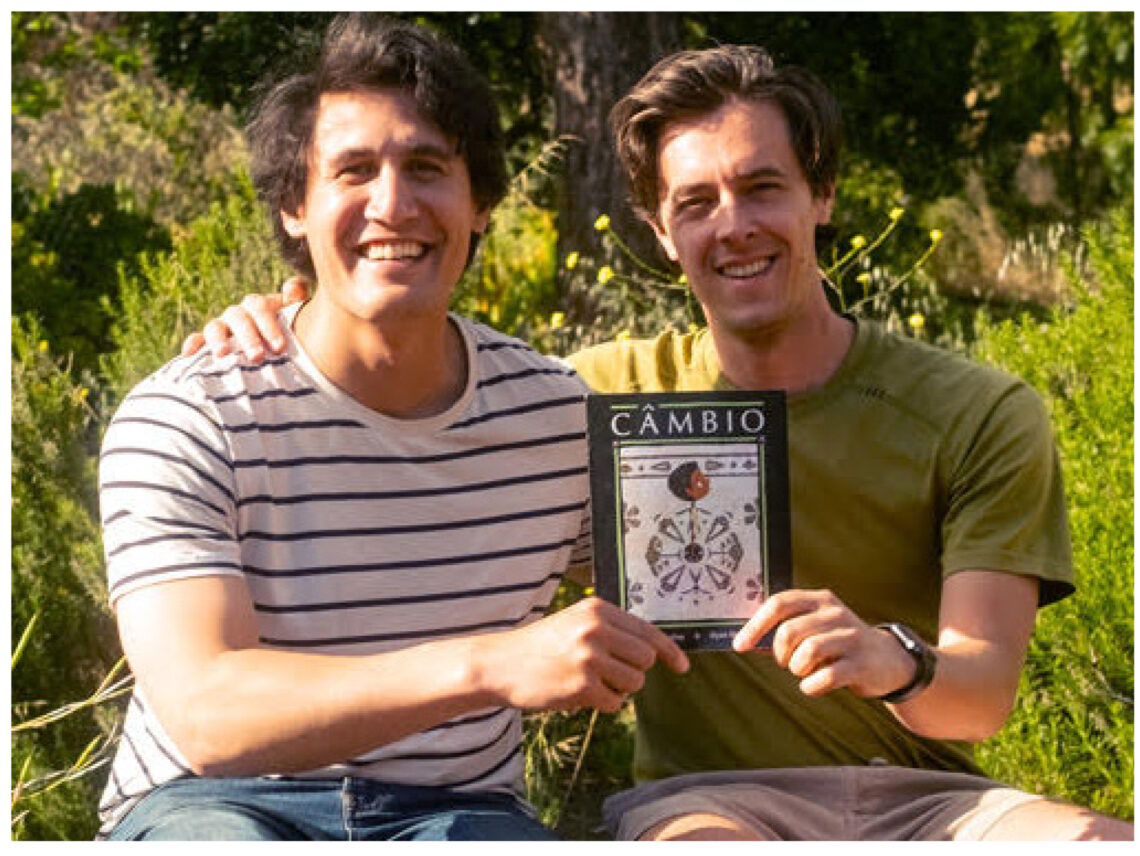
Professionally, I felt well prepared for my interview with Santa Cruz-area author Taylor Lahey. I expected a straightforward conversation about his children’s book, Cambio. But as our discussion ranged from comic books to cryptocurrency — with detours into big ideas about systems thinking, value creation, spirituality and civic design — it became clear pretty quickly this would be anything but a standard author interview.
At the center of it all is Cambio, Lahey’s children’s book about an idea so simple, it almost feels radical. It tells the story of Curitiba, Brazil, where residents collected trash that could be exchanged for bus tokens — a system that helped clean neighborhoods, improve public transportation access and, over time, even functioned as a kind of informal community currency. Today, a version of that program still exists, allowing people to trade recyclables for fresh produce from local farms.
Lahey grew up in Castro Valley but has family ties to Santa Cruz. As a child, he first spoke Mandarin at home and remembers struggling at times with English, gravitating instead toward visual storytelling — comics, cartoons and imagery that he could more easily relate to. That early connection to illustrations led him to pursue a degree in Visual Communication from UC Davis and eventually a career in graphic design, branding and animation.
What’s interesting is he never set out to write a children’s book at all. He originally envisioned Cambio as a wordless graphic novel, given his background in visual storytelling. But he ultimately found the courage to express his voice as a writer.
He first learned about Curitiba while working in the tech world, where it was used as an example of how communities can rethink value — not just in terms of money, but in how cultures care for people and the environment.
Deeply intrigued, he pitched a project through his work that allowed him to travel to Curitiba, where he spent several weeks meeting with urban planners, civic leaders and residents to better understand how the system worked in practice. It was there, in a city designed with intention by architects and planners, that he began to see how systems can shape everyday behavior. “If you set certain conditions, you get certain outcomes,” Lahey says.
What mattered to him wasn’t just the mechanics of the program, but its impact on culture — how it shaped the way people lived and treated one another. “It’s not about money,” he says. “It’s about a system we can agree is good — transportation for all, clean neighborhoods, clean waterways. It’s hard to argue with those things.”
The experience left a lasting imprint, eventually becoming the foundation for Cambio. In the book, that idea is distilled into a simple story — one Lahey shaped to be accessible, universal and easy to understand. It’s told through the eyes of a child growing up in a place where caring for the environment and for one another isn’t unusual — it’s simply part of everyday life.
Now, Lahey is working to bring that idea to Santa Cruz. On April 11, he’s a key collaborator in Bridging the Gap x Santa Cruz Green Exchange, a San Lorenzo River cleanup event that, for the first time this year, will also support downtown businesses.
Volunteers will collect and document litter, using the Save Our Shores Marine Debris app to track trash totals. What sets this event apart, is for the first time, participants will earn Downtown Dollars or gift cards in exchange for the trash they collect. It’s a simple but transformative idea: clean up the river, earn real value, then put that money directly back into local businesses.
Now in its 7th year, Bridging the Gap is a river cleanup and habitat restoration effort led by Jennalee Dahlen, founder of Yoso Wellness Spa, and Melissa Begin of Visit Santa Cruz County. This year, Lahey is introducing the Green Exchange model, adding a new element to the event.
Additional partners include Save Our Shores, the Coastal Watershed Council and Downtown Santa Cruz. The goal is ambitious: to clean the entire stretch of the San Lorenzo River through downtown while creating a model that could be repeated and expanded over time.
As Lahey puts it, “You clean up the river, we’re going to give you some value downtown. It benefits businesses, it benefits you as a resident and it benefits the environment we all share. If you take care of Santa Cruz, Santa Cruz takes care of you.”
For Lahey, the book and the event are part of something much bigger — a deeply held belief that storytelling can shape the way communities function in the real world. It’s a bold idea, and at times, his thinking stretches far beyond the practical realities most of us are accustomed to dealing with day to day.
He talks about “systems thinking,” about reimagining value and even about designing culture itself through storytelling — concepts that can feel abstract and challenging, but inspiring, hopeful and aspirational at the same time. But underneath the bigger vision is a much simpler question: what would it look like if taking care of a place — and each other — was something communities actively built into everyday life?
When I asked Lahey about the push back or potential criticism — that these ideas can sound naive, overly altruistic or unrealistic in a world that often leans more cynical than hopeful — he didn’t hesitate.
“In Curitiba, this program is more than 50 years old. So, there are people who have lived their entire lives with this,” he says. “For them, this isn’t some big idea — it’s just how things work.”
Whether something like that can take root in Santa Cruz remains to be seen. But for Lahey, the goal isn’t to replicate Curitiba overnight — it’s to start and see what happens. The April 11 Green Exchange is, in many ways, a first test. It’s a chance to bring people together, try a different approach and measure what kind of impact — environmental, economic and social — it might have.
A key part of the vision, according to Lahey, is transparency — clearly showing what’s collected, what’s given in return and quantifying the economic value. He explains it like this: “We want to show this is how much trash you picked up. This is how many rewards we gave away. This is how it impacted the local economy.”
If it works, even on a modest level, it could begin to shift how people think about their role in the community. Not just as individuals passing through shared spaces, but as participants in maintaining them — with a tangible connection between effort, economic rewards and the health of the place itself.
For families, it’s also a rare opportunity to show their children that this kind of work matters. Kids who grow up helping clean the river — earning something in return and seeing the immediate results of their actions — may begin to understand that they can shape the communities they’re part of, not as an abstract idea, but something they see firsthand: what they do makes a difference.
By Joan Hammel