
Some of the best children’s books stay with us because they give us something to wonder about after the last page is turned. Two new picture books do that in very different ways. One invites children to invent new words for the natural world, and one imagines what could happen when a safe haven is threatened by things we can’t control.
Wildspeak
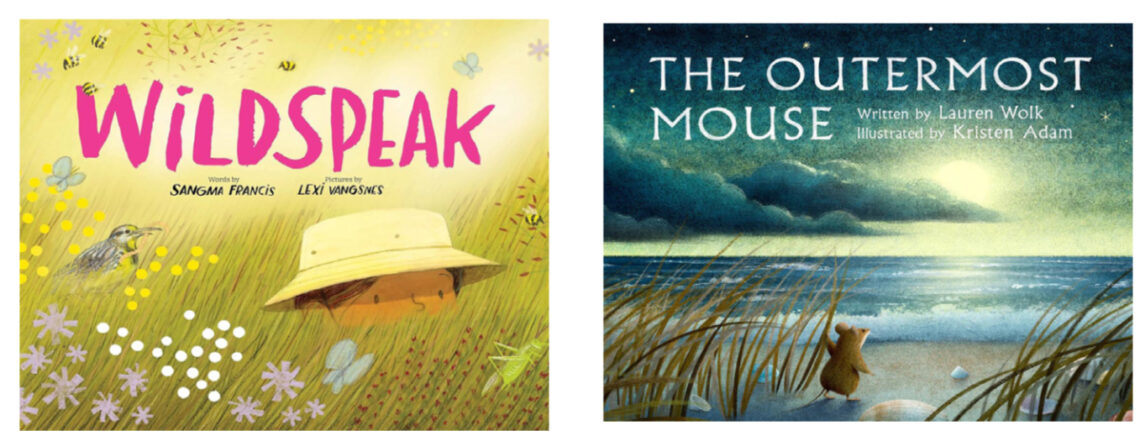
Exploring nature through imagination and creative language, is a joyful invitation to step outside and listen with more than our ears. Two young girls take a walk through nature with their mother, discovering the small wonders around them and finding words for what they see and feel. Author Sangma Francis shows us that nature already has a language, but children can add to it. She shares real words to learn, but Wildspeak also encourages children to create words of their own. That may be the book’s most memorable gift. Children are natural word-learners and word-makers. They mash sounds together, rename things, and often come up with descriptions that feel fresher than adult language. A glittering stream might need a new word. Maybe a cloud at sunset, a field full of seed-bearing flowers, or the strange feeling of standing under trees while the wind moves through them. This isn’t only playful; it teaches attention too. To name something with an invented word, a child must look closely. What color is it? Does it have a scent? Is it soft, spooky, or sticky? A made-up word can become a tiny poem. The illustrations by Lexi Vangsnes support that sense of discovery and invitation, mixing new words and familiar images. It would be especially fun to read before a walk, asking children to think of their own wild words. The results can be silly fun, or surprisingly beautiful.
The Outermost Mouse
The Outermost Mouse by Lauren Wolk, illustrated by Kristen Adam, begins at the edge of the world (or at least at the edge of Cape Cod) where a small mouse lives in a beloved seaside house surrounded by sand, sea and sky. The mouse loves the warmth and shelter of the house, the treasures inside it, the ticking clock, the light, the wind, and the wild beauty of the shore. Kristen Adam’s watercolor illustrations create a real sense of place, cozy yet immense to a tiny mouse. Then the sea begins to change and the beach shrinks. The waves come closer as a storm approaches, and the other animals understand that it is time to flee inland. The mouse tries to warn them, and she tries to protect what she loves. She works hard and builds barriers, refusing to believe that her precious house could be carried away. That is where the book becomes more than an animal story. The Outermost Mouse relates to the kind of attachment that children have to places of security — a house to come home to, a favorite tree to climb, a blanket fort to hide in — a corner of the world that feels like theirs. When the storm finally lifts the house from the shore and carries it out to sea, the story shifts from loss into adventure. The house becomes a ship. The mouse becomes its captain. The ending is open, and that is part of its power. Some readers may worry about the mouse, but the final image suggests something braver and brighter. She is not shown as defeated. She looks thrilled, astonished, alive to the wild possibility ahead. The sea that threatened her home has also opened the whole world. That makes The Outermost Mouse a wonderful book to keep imagining after the last page. Where will she go? Will she land at a Santa Cruz harbor, in a quiet cove, or on a wild shore with welcoming animals? Perhaps a different destination after each reading. Children may want to draw maps of her voyage or invent the next chapter. The book gives children a brave little traveler and lets their imaginations sail with her.
By John Louis Koenig