
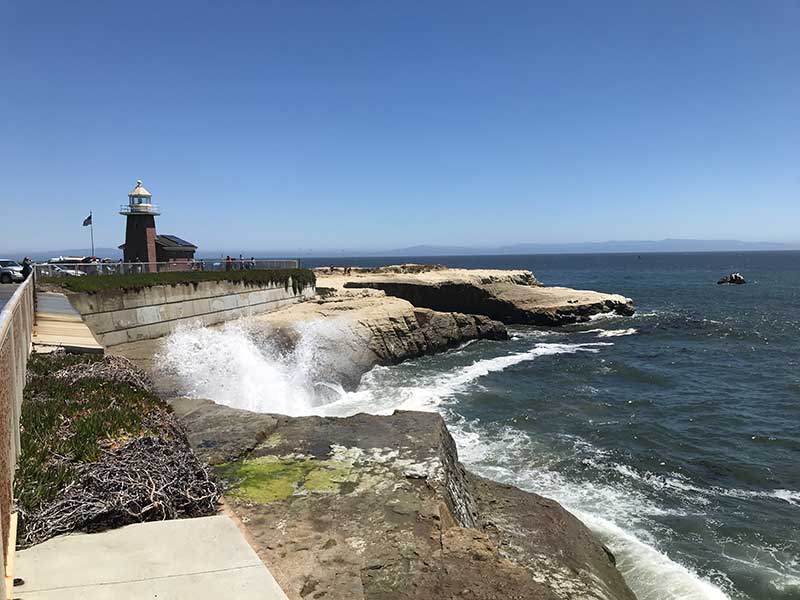

Never turn your back on the ocean. Never. Our ocean is called the Pacific, which means “peaceful,” “tranquil.” It usually is. And that’s how the Pacific can set a trap, by being calm first. Rogue waves, also called sneaker waves, are sets that arrive after a lull to push farther up onto the land than the ones before them (californiadiver.com/never-turn-your-back-on-the-ocean/). They can catch people exactly when they’ve decided it’s safe to stop paying attention. Let’s start with the last time I turned my back on the ocean.
Actually, Laurence Bedford started it. My hiking group, we sarcastically self-name The Pillars, likes to walk as close to the ocean as possible. Laurence starts a game of timing the waves crashing against the igneous outcrops.
When the waves pull back you’ve got a few seconds to run over the bare, wet sand, around the volcanic rock outcropping to make it to the next inlet before the next wave lands. Major fun. The tide is coming in fast; our windows of exposed sand are getting shorter by the minute.
Sleepy John Sandidge looks at the appearing and disappearing paths around the outcroppings, nods at the waves crashing against the rock and says, “No way.” He scales the rock on all fours, up to a flatter rock shelf over the volcanic ridges and strolls north towards the dry beach. Ben Rice says, “Goin’ with ya,” and joins him. But Laurence. Damn. Sometimes the Frenchman scares the holy-crimmoly-hell out of me, and I follow him anyway.
I’m running over wet sand around the outcrop when the rogue wave hits me from behind. The wave turns me, so both hands slap against the rock. The ocean flows over me and presses me flat against the ancient basalt like I’m a flower being pressed in a book, dumb as a daisy. The wave crashes high up on the volcanic rock as it has for millions of years, only this time the violent meeting of land and sea has caught a fool.
The 10-foot wave finally stops it’s climb up the outcrop and looks down on me. Still water does not convey it’s denseness of mass, the unimaginable weight, heavier than a bad decision, until it starts to move like a backyard swimming pool dropping out of the sky sideways, a moving cliff that weighs more than a house.
There’s a particular clarity that comes when you realize that moment when the ocean stops supporting you and starts relocating you. I hear that sucking roar begin, a sound that says I’m going with it to pinball against the igneous shards behind me. There is a flash of light as my sunglasses vanish. Somewhere deep in the wiring of an older animal, instinct takes over. Faster than thought, I hook my right hand over a knob of rock above me. Fear turns my grip to iron.
Tons of water rush past and pull on my body, but my hand holds. The wave spends itself; my body lowers with it until I release the rock and pull my face out of the wet sand. The wave withdraws as if none of it had been personal at all. It’s like the wave was Sal Tessio at the end of The Godfather, “Tell Mike it was only business.”
Waves just do their business. They are wonderful. They create the very sand that make up the beaches of our vacation destinations. They let you surf on top of them. When they crash into the rocks, they fill the air with a spray pattern that is as unique as a snowflake. But they don’t look out for your safety.
“Don’t turn your back on the ocean” sounds like something printed on a lifeguard tower that we nod at and ignore. But at our own peril. It doesn’t just mean “take a look at the water”, it means keep your body turned to face the ocean. Doing this occasionally doesn’t work. The Pacific doesn’t escalate gradually; it can be smooth as glass and then jump to a violent conclusion. Show it respect.
An older surfer told me, “The ocean runs on rhythm, until it doesn’t. Stand where you think you’re safe, then take three more steps back. Watch the water for a full minute before you commit to where you’re standing and keep watching. Quiet stretches are often the prelude to a surge.”
If you take your family to West Cliff, Davenport, or any of the stunning places where land drops into the sea, please remember rocks are not a safe place to hang. They are where the water does its most violent work. A wave that is harmless on open sand can become deadly force when it meets stone. When the water pulls back, it’s not done, it’s gathering. It’s never done.
For families, there is another layer to this. Kids are lighter; they go down faster. And for the geezer set, like me and my hiking buddies, we don’t have the luxury of acute balance or quick reaction time. A rogue wave knocked me flat when I was younger and friskier. Any wave knockdown in cold Pacific water now could make me inhale at exactly the wrong moment.
None of this means you shouldn’t walk the edge. Walking close to the ocean is one of my favorite things in life.
The whole reason we walk out there is to feel something larger than ourselves, to stand where the land ends and let the colossal scale of it reset us. Just don’t confuse beauty with safety. On some cosmic level, waves love you. But they have work to do. It’s just business.
By Richard Stockton





One Comment
Andea Jennings
When I was eight years old I went fishing with grandparents on the ocean in New England, Conn . Sitting on the dock, As I was daydreaming with the sun in my face I heard the ocean tempting me to jump in! I never learned to swim. The temptation was constant and I felt if I didn’t hold on to something I would jump in. This is a true story. I’m 69 yrs and remember this like it was just yesterday . No, you are the first person I be told