
Understanding Senate Bill 54 and what it means for your daily waste sorting and the future of regional sustainability. Sorting Out the Future of Recycling: An deep dive into California’s new anti-single-use packaging legislation and how it aims to transform recycling practices in Santa Cruz County for a more sustainable future. Recycling, Senate Bill 54, Santa Cruz, waste management, circular economy, GreenWaste, environment, plastic reduction, sustainability. Environment. A clean, professional shot of a modern recycling center, featuring organized sorting bins and conveyor belts bathed in bright, natural light, symbolizing clarity and environmental stewardship. 75, 48, 440, 954. Sorting Out the Future of Recycling. Environment.
Recycling can be complicated. But a landmark anti-single-use packaging law from Sacramento will simplify how Santa Cruz County recycles in the years to come, according to local waste and recycling officials.The Impact Of Senate Bill 54The Plastic Pollution Prevention and Packaging Producer Responsibility Act, Senate Bill 54, will make recycling easier for consumers and more profitable for local governments as it reduces Californians’ exposure to toxic plastics.
Plastic polluters must reduce their output by 25% and pay up to $500 million a year to offset the costs to health and the environment — what some geologists have started calling the “Plastocene” epoch because the amount of plastic will be visible in the geographic record millions of years from now.Local officials are excited about what this could mean for creating reliable markets for plastics and reducing the public confusion felt by residents who recycle in the city or the county.”SB 54 is going to be a game changer,” said Tami Stolzenthaler, senior project environmental analyst for Watsonville. “In fact, everyone in California will be under the same umbrella.
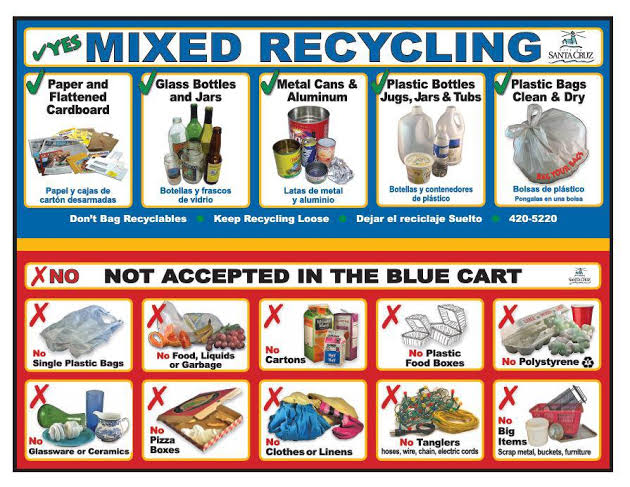
We’ll have to accept the same materials to make it more standardized.”Addressing Recycling ConfusionCurrently, the county accepts clamshell containers, snappable plastic takeaway boxes, through its hauler, GreenWaste. The city’s lack of clamshell recycling is one of several differences between what the city of Santa Cruz and the county accept, leading to confusion for residents.
Ultimately, this contributes to 30% of total recycling at the city’s Resource Recovery Facility on Dimeo Lane being discarded, or “wishcycled,” according to the city.There are other common items that can be recycled in the county that cannot be recycled in the city because of the large scale of GreenWaste, according to Christina Horval, zero waste outreach coordinator for the County of Santa Cruz.
“Here in the county we do have GreenWaste, so our service here is better,” Horval said. “We take a lot because we’re bigger, and we can get that end market more than the city of Santa Cruz.”Plastic film, plastic containers, milk containers, aseptic containers and soymilk containers are all accepted by the county.
These materials are sorted at the GreenWaste Resource Recovery Facility in San Jose, which is equipped with AI smart cameras pointed at the conveyor belt to remove trash. The system recovers 85% of the 45 tons of recycled material it sorts per hour. Recycling from more than 300,000 customers in the region and the city of Scotts Valley goes there too.Future Of Waste ManagementComing into effect Jan. 1, 2027, is an approved list of at least 50 recyclable or compostable materials that recycling agencies in California will have to accept. A common clamshell ingredient, polyethylene terephthalate, or PET, is on the list. Polyvinyl Chloride, PVC, is not.The city does not organize its recycling by type of plastic, but it has a nifty recycling guide (search “What Goes Where Guide” at santacruzca.gov) and accepts clean jars and jugs, encouraging customers to wash items before recycling.Jurisdictions can either expand the types of recycling they offer or request an exemption from CalRecycle, according to the text of the regulation.
The city did not respond to a request for comment on whether service would be expanded or an exemption requested before publication.”California is shifting the responsibility of managing single-use plastic and packaging onto the producers. New packaging reforms lower waste costs for communities and decrease garbage and pollution across the state,” said Yana Garcia, secretary for environmental protection, in a press release from CalRecycle. “This approach pushes producers to innovate and design packaging that truly supports a circular economy.”Before the recent rise in oil prices, materials such as PET had seen a massive drop in their resale value to $60 a ton, down from $1,700 a ton in 2016, according to Beau Hawksford, administrative analyst at Recycling and Solid Waste Services.
This was not enough money to make it economically viable for the county’s two transfer stations and a small city like Santa Cruz.The creation of a statewide market for PET may offer a solution to the problem the city has faced. However, PET is not easily recyclable because of how it is heat-treated in the manufacturing process and some clamshell plastics, such as PVC, may face steeper declines or bans, according to CalRecycle. In 2025, polystyrene, commonly known as Styrofoam, was banned for single-use after the state deemed a 25% recycling threshold for the compound was not achieved.
SB 54 was originally passed in 2022 and mandates that all packaging be recyclable or compostable across the state by 2032. A 10% reduction in single-use plastic goes into effect next year.
By William S. Woodhams