

Trees inspire wonder and imagination. Unforgettable trees appear in famous stories, from The Lord of the Rings to The Swiss Family Robinson. Every tree has its own story too. Some trees mark old neighborhoods. Some tell stories about fashion, history, and the weather they grew in.
In Santa Cruz, many of those stories are scattered downtown. Leslie Keedy, the city’s urban forester for 26 years, knows where to find them. She has built her career around caring for our vast population of trees and she has a gift for making them seem less like background scenery and more like characters.
“Talking about trees is probably the most fun part of my job,” Keedy says. She is the kind of expert who knows a lot but has not lost the beginner’s amazement.
Santa Cruz, Keedy says, is especially rich in trees because our climate allows an unusual variety to grow. Our trees have come from rainforests and deserts, sharing the land with native actives. Some tell stories from a century ago, and back toward the mission period. Some are simply wonderful weirdos.
One of the best ways to meet these trees is through Keedy’s Downtown Tree Walk, a free annual tour, where you can learn how the trees grow, where they come from, and how they remind us of our history.
Here are just a few of the towering friends you will meet.
Time Travelers: The Stately Victorians
We picture old-time Victorian explorers like Indiana Jones or Lara Croft, searching for lost temples and ancient ruins. But in the 1800s, they also loved exotic plants. Victorian homeowners often used trees and shrubs to create drama, status and surprise. A Victorian house was part whimsical architecture, with gingerbread trim, tall windows, and fancy woodwork.
One common touch of the time was two Canary Island palms by the entrance, and a yard like a botanical trophy case.
Reminder Of The Missionaries
Long before Victorian homeowners were decorating Santa Cruz with exotic trees, missionaries and Spanish settlers were moving plants from place to place along the California mission chain.
“They would bring them from mission to mission,” Keedy says. “At Mission Santa Barbara and here at Mission Santa Cruz, there’s the Chilean wine palm.”
The young palms grow so slowly that planting one is a gift to the future, not a source of instant shade. You plant it because someday someone will stand under it and wonder, “Who put this here?”
Jurassic Park Trees: Ancient Scenery
Some trees seem to belong to a distant, primeval age. The bunya-bunya tree from Australia is one. It looks prehistoric, as if a dinosaur might wander into the yard and munch it for lunch.
The cones can be huge, sometimes weighing many pounds, like a bowling ball with seeds inside. They fall, so be careful!
“The bunya-bunya trees are planted in association with Victorians as well,” Keedy says. She points to examples near Victorian homes at Chestnut and Walnut and on Green Street.
Related to the monkey puzzle tree, its scientific name is Araucaria bidwillii — but it’s more fun to say bunya-bunya.
Another tree that looks as if it escaped from a prehistoric movie set is the floss silk tree. Two grow at City Hall, planted by Keedy in 2005.
“The floss silk tree has these really scary spikes that stick straight out from the trunk,” Keedy says. The silky fiber in the seed pods is extremely buoyant, making it useful for stuffing life jackets, pillows, mattresses, upholstery, and insulation.
Fairyland Trees: Purple Rain And Pink Showers
Some downtown trees are less spooky and more magical.
Jacarandas are famous for purple-blue flowers that make a street look enchanted. They are native to South America and came to Santa Cruz from Mexico. A jacaranda in bloom drops blossoms like purple rain falling onto sidewalks and cars. “Those are just beautiful trees,” Keedy says. “Absolutely gorgeous.”
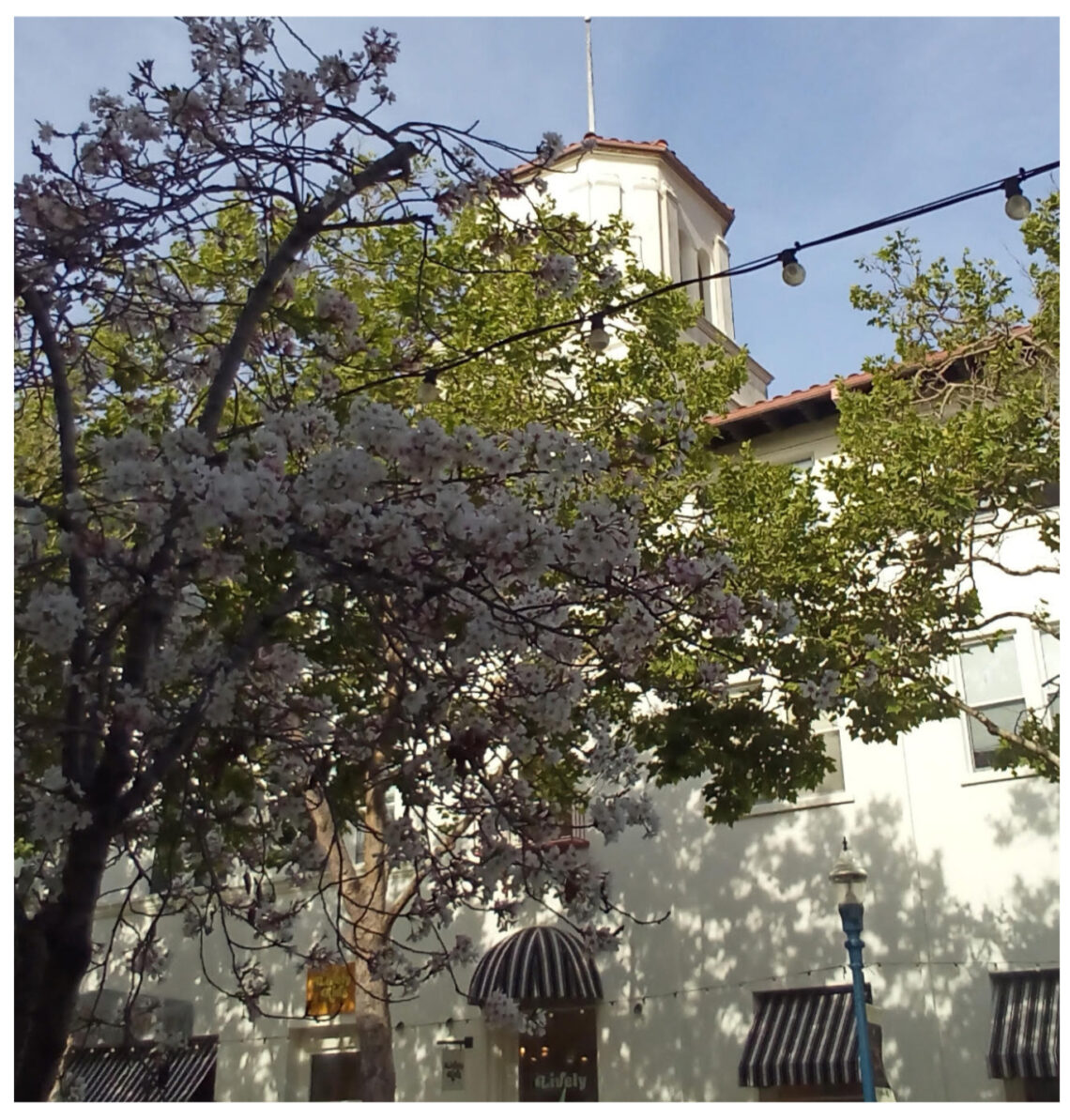
On Pacific Avenue, flowering cherry trees bring a different kind of magic that connects to East Asian horticulture.
Keedy says the downtown cherries include Akebono cherry with soft, pale blossoms and Kwanzan cherry with vivid pink, double flowers like tiny pom-poms. The city also added crape myrtles to avoid monoculture. When too much of one plant grows in one place, if a pest or disease loves one tree, the whole street can be in trouble.
The Haunted Forest Tree
In winter, the black walnut tree on Cedar Street looks like a wanderer from a witching wood, with stark, dark bare arms reaching ominously. In summer, its black branches come to life, filling its crown with dense green leaves, a true legacy tree of Santa Cruz.
“It was one of the original trees that was planted in our community for sure,” Keedy says, “at least 150 years old, and maybe closer to 200.”
Someone long ago planted it. But who and why, we do not know. Its lost history adds to its mystery. Years ago, the city wanted to remove the big legacy tree, but public outcry helped save it. Instead, some branches were cut, but the crown grew back. Today, it’s huge and growing, lost royalty on a downtown back street, still awe-inspiring.
The Tree From Outer Space
Tucked into the City Hall courtyard is one of Keedy’s hidden gems: the firewheel tree, a native of Australian rainforests.
“It just looks like a boring, weird-leaf looking tree in the corner,” she says. But at the right time, the tree produces bright red flowers that Keedy compares to “prehistoric plastic flowers from outer space.” You might miss it if you walk too fast, but if you see it, suddenly City Hall has aliens.
At Home In Santa Cruz
Santa Cruz loves our redwoods, and why wouldn’t we? Coast redwoods are among the tallest trees on Earth, and the Santa Cruz Mountains are part of their natural home range.
But Keedy offers a twist young readers may appreciate: your parents or grandparents could be older than some towering redwoods. “A lot of people think our redwoods are old,” she says, “but they’re often only about 60 to 80 years old. They just grow fast and they’re happy here.”
Keedy once investigated a redwood that some people claimed was 200 years old. “I got the yearbook out for Santa Cruz High School,” she says, “and in the mid-’60s that tree wasn’t even there.”
The Trees Of Great-Grandfathers
“When I think about our legacy trees in Santa Cruz, it’s the Cliff Street Cypress, the Magnolia downtown, and the Black Walnut on Cedar Street,” Keedy says. “They are probably our three oldest trees.”
The old Cliff Street Cypress at the top of the Cliff Street walkway on Beach Hill may be about 200 years old. Sadly, Keedy says it is beginning to die. “It’s slowly aging out,” she says. We want the oldest ones to last forever, but even the great ones have lifespans.
A very old tree gives a town a kind of memory. It stood there before most of us arrived. It shaded people we never met. It watched Santa Cruz become Santa Cruz.
Downtown Tree Walk 2026
Santa Cruz is a surf town, a college town and a downtown full of human stories. It’s also a forest town, with trees whose stories are waiting to be discovered.
“I think the more you know,” Keedy says, “the more you realize how much more there is to learn.”
That is the spirit of growing up curious.
On Saturday, July 18, from 9am to noon, join City Urban Forester Leslie Keedy for a free guided tour of significant and historical trees in the city’s downtown urban forest. Meet promptly at 9am at the City Hall Courtyard across from the Public Library. Advance registration is required through the Santa Cruz City website. Call 831.420.5270 for information.
By John Louis Koenig