
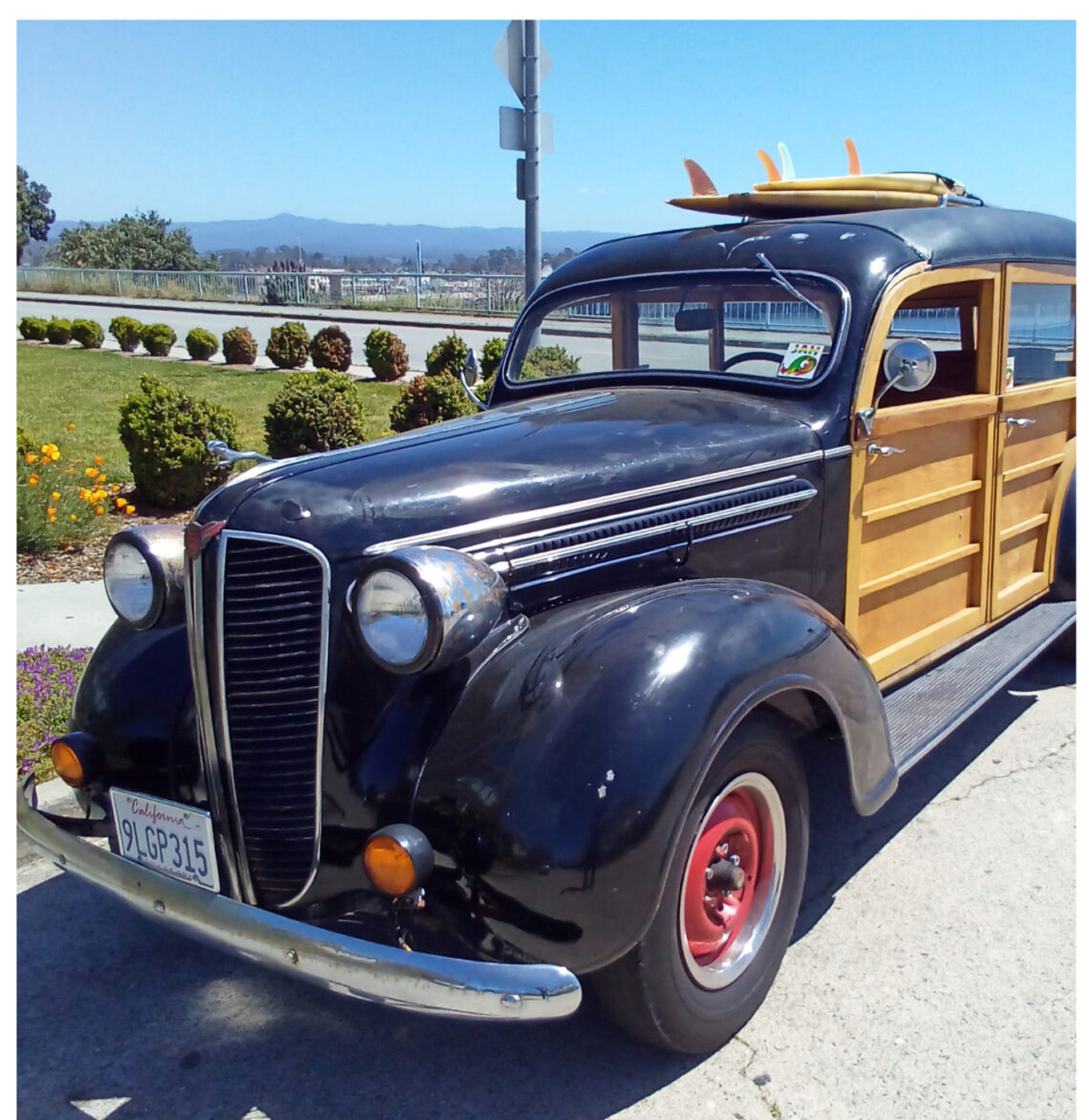

Try asking your car-loving kid how modern cars compare to the classics, and I’ll bet you get an eye-roll, or a stare that says, “you’re kidding, right?” The cars of today, for all their engineering brilliance, have a way of blending together into one long parade of sameness, sleek and smooth and largely indistinguishable. “Why are all the older cars so much cooler?” kids ask.
But lead that same child down the Santa Cruz Wharf in June when the woodies roll in for their annual visit, and something entirely different will happen. Fingers point, and eyes go wide, full of excited curiosity. What IS that? Why is it made of wood? Why don’t we make them now?
Woody wagons are some of the most prized and storied automobiles ever made. Shining with varnished panels of ash and maple, they look like something a ship’s carpenter dreamed up on an inspired afternoon with a hint of steampunk cool and the warmth of living wood. In Santa Cruz, that old-time cool has never gone out of style.
Born Of Practicality, Beloved For Beauty
To understand the woody, we go back to the time before 1910, when autos were basically motorized carriages. Wood was the standard material for carriage makers, and stamped steel was expensive. For a long wagon body, wood framing was the most practical way to build a large, enclosed structure.
In 1920, Henry Ford bought more than 400,000 acres of forests in Michigan and built a plant nearby to handle the production—cutting timber, running a sawmill, and forming body parts of hard maple, with birch or mahogany inserts.
The people building these long wagon bodies learned from a tradition of wooden boat construction, where spanning large dimensions with curved structural wood was a part of their craft. Even when steel frames were used, coach builders completed the automobile by fitting a wood body to the frame, and boat builders were skilled in this type of work.
And here’s a crazy trivia fact to impress your friends: Kingsford Charcoal began when the frugal Ford hired a chemist to invent a way sell the tons of waste woody-sawdust from the factory mill. He devised a formula to compress the sawdust into the “charcoal briquettes” still sold in every grocery store!
Rise And Demise
The original woodies were practical carriers for commercial transport. Later they became known as “station wagons” when they became popular for carrying well-to-do travelers from train stations to fancy resorts.
In the mid-1930s, the woody had transformed from workhorse to prestige purchase with extraordinary craft involved in building. Some woodies required more than 150 pieces of wood to construct, each fitted and finished by hand. Many owners would revarnish their prized woody wagons every year to keep them shining like new.
But, by the 1940s, steel was winning the war of materials. Wood station wagons were a low production and higher-priced product, labor-intensive and costly to make. By 1953 the last true American woodie had rolled off the line as wood was replaced by kitschy, painted panels and, eventually, the deeply unfortunate era of fake wood-grain decals.
Surf, Sand And A Second Life
Here is where the story takes a turn that no one could have predicted. The original woodies faded into relative obscurity by the 1950s, but California’s climate had preserved what the East Coast’s wet winters had rotted away. In the 1960s the blossoming subculture of surfers discovered the old woodies, rotting in yards and garages all over America.
In need of inexpensive transportation, surfers could buy woodies cheap, and they were perfect for lugging around the long surfboards of the time. In those days surfers didn’t restore their wagons, they just kept them going. The varnish peeled, the wood weathered, and that was cool. Woodies had found their true calling.
Pop music immortalized the wacky wagon when the 1960s duo Jan and Dean turned a Brian Wilson song into a smash hit called “Surf City.”
“I got a ‘34 wagon and I call it a Woody
Surf City here we come
You know it’s not very cherry, it’s an oldie but a goodie
Surf City here we come”
Those “oldies but goodies” have only gotten better with age.
Woodies On The Wharf: Years Of Wonder
Santa Cruz is truly “Surf City,” a place where the beach is a way of life and the woody is at home here. It’s a part of our culture, like Steamer Lane, the Boardwalk and the Wharf.
Which is why, thirty years ago, the Santa Cruz Woodie Club hosted the first Woodies on the Wharf.
We’ll celebrate the 30th anniversary of Woodies on the Wharf on Saturday, June 27 starting at 10 a.m. It’s Northern California’s largest woodie gathering, featuring hundreds of woodies. Be there for the Woodie Parade off the Wharf at 3:30 p.m. after the Awards Ceremony and watch the wagons roll. You’ll understand why collectors prize these cars like found treasures, inspiring such wonder and curiosity.
The woodie is that rare creation whose story spans a century. No two woodies are identical. In an age of robotic, assembly-line sameness, that singularity is nothing short of rad.