

You are not alone in wondering about what it means to hold the 4th Thursday of November as a day of gratitude, known to some as Thanksgiving, and to others as the Day of Mourning. In a country rooted in colonization (which still continues today), we have been conditioned to ignore the uglier parts of our country’s history and how the experiences we take for granted today came to be.
At Positive Discipline Community Resources, we invite you to stay curious and examine the ways in which we have the power and privilege to bring humanity and compassion into our parenting and teaching of traditions.
“The antidote to feel-good history is not feel-bad history, but honest and inclusive history.” — James W. Loewen, Lies My Teacher Told Me: Everything Your American History Textbook Got Wrong.
WAYS TO STAY CURIOUS
Sharing the uglier parts of history can be done with language that is developmentally appropriate. Instead of avoiding these discussions in favor of comfort, help your children work through the humanity of their emotional reactions.
- 1. Honest History (without erasure). Find age-appropriate ways to go deeper and learn together with your children about the past. Begin by showing respect and acknowledgment for the people who stewarded this land before us.
- 2. Address “how”, not if we are complicit. Thanksgiving is but one of many holidays we should question for our passive observance or active participation.
- 3. Appreciations and Acknowledgments. Do you know whose land you are on? Fuel your children’s and your sense of appreciation for a rich and diverse living history.
- 4. You do not have the answers to everything, and that is okay. You may be learning and unlearning a lot. Stay hopeful that it is better to try and do better now that you know better. Without staying complicit, know you are doing your part to fuel a brighter and better tomorrow for all our children to inherit a safer and more equitable tomorrow.
WAYS TO HONOR THE PAST: LAND ACKNOWLEDGMENT
Celebrating Thanksgiving in the Santa Cruz area? Here is the Land Acknowledgment to consider reciting before your meal.
“The land on which we gather is the unceded territory of the Awaswas-speaking Uypi Tribe. The Amah Mutsun Tribal Band, comprised of the descendants of indigenous people taken to missions Santa Cruz and San Juan Bautista during Spanish colonization of the Central Coast, is today working hard to restore traditional stewardship practices on these lands and heal from historical trauma.” — This land acknowledgment was co-created by the Amah Mutsun Tribal Band Chairman and UCSC’s American Indian Resource Center
GOING BEYOND THANKSGIVING MYTHS
- The name Wampanoag means People of the East, or People of the First Light (referring to their coastal location). Today, approximately 4,000 Wampanoag people live in New England.
- The Wampanoag people lived in the Plymouth area for over 10,000 years before Europeans arrived and began the inhumane practice of stealing Indigenous people and forcing them into slavery (at least 100 years before the Pilgrims arrived).
- When the Pilgrims arrived, they settled in an area that a Wampanoag village had previously been forced to abandon after disease brought by Europeans led to an epidemic killing of nearly two-thirds of their Wampanoag people.
- The Wampanoag leader, Ousamequin, offered an alliance, thinking that the Pilgrims could, in turn, help his people fend off their rivals, the Narragansetts.
- Over the next 50 years, this alliance disintegrated as colonists imposed on land and Indigenous sovereignty, culminating in a brutal and vicious war known as Metacom’s Rebellion (led by the second oldest son of Ousamequin).
ORIGINS OF THANKSGIVING MYTHS
- Indigenous communities had been (and continue to be) engaging in rituals around giving thanks throughout the year, long before they shared a meal with Pilgrims in 1621.
- In 1769, descendants of the Pilgrims worried that they were losing their cultural relevance and started the idea that the Pilgrims were the fathers of America.
- It wasn’t until persistent letter writing by Sarah Hale, a white author and activist, led to Abraham Lincoln instilling Thanksgiving as a national holiday in 1863. Lincoln hoped the holiday would unify the country during the Civil War, and Hale continued to publish recipes and stories associated with many of the Western traditions observed today.
RETHINKING OUR PRACTICES
- Brace this moment as part of a larger movement to do better and decolonize our parenting. Much like we strive not to be punitive nor permissive, we should be working to ensure we are not causing harm and normalizing injustice for the sake of comfort.
- Stop participating in Thanksgiving pageants or constructing headdresses if you are not an Indigenous person. Doing so is engaging in cultural appropriation and disrespects Indigenous people and the cultural meaning these artifacts hold, even if that is not your intent.
WHAT TO DO ON THE 4TH THURSDAY OF NOVEMBER:
- Honor the day as the National Day of Mourning in solidarity with the United American Indians of New England. Learn about the different perspectives Native American people hold about Thanksgiving.
- Learn about the ways Indigenous people have and continue to resist, create, advocate, dream, work, strategize, celebrate, dance, and create community.
- Reflect on the ongoing forms of colonialism, both past and present. How does colonization continue to impact our lives? (i.e., poor/broken land stewardship/stripping away natural finite resources) How does it impact our lives differently based on power and privilege?
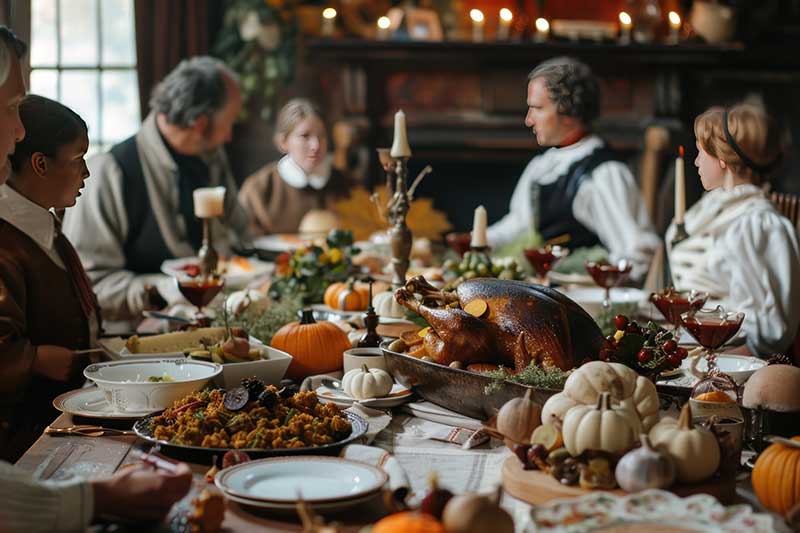
- Celebrate a harvest feast and use this as one of many days in which to take stock of what you are thankful for, while also acknowledging the history of how this holiday actually came to be.
- Share this information with family and friends; learn about and amplify Indigenous voices all year round.
For further exploration, visit PDCRcc.org to view this tip sheet filled with educational links
The authors do not want to speak for Native American people, and instead offer this in an ongoing reflection around the privilege that comes with residing on stolen land and unduly benefiting from colonialism. If you see something that requires revising or deeper reflection, please let us know.
- Stephanie Barron Lu engages in her own decolonial work around how forced colonialism upon her Indigenous ancestors led to the Guatemalan, Chinese, and Mexican people she identifies with.
- Stephanie Tam Rosas works on the white privilege afforded to her by her lighter skin and cultural capital from her 2nd generation Russian mother, and her mixed-race identity due in large part to her father who immigrated from Hong Kong.
- Special appreciation to our content editor, local nonprofit leader, activist, Theresa Cariño whose multicultural and biracial background include Native (Yaqui), Mexican and Irish